Showing posts with label marathon. Show all posts

Sunday, November 12, 2023

2023 New York City Marathon

New York City Marathon. Wow! What an amazing experience! I’ve been told that the NYC Marathon is a great running event, and that the course is tough. Both statements are accurate.  


The NYC Marathon was my second marathon in just four weeks. I had just run Chicago and set a personal best of 2:29:38. I didn’t have any specific time goal for NYC, but I figured with the tough course and a double marathon four weeks apart, running anywhere between 3-5 minutes slower than Chicago would be a good day. The one goal I did set for myself was to try and place Top 3 in the M45-49 age group. 

I was grateful to have been accepted into the sub-elite program. The experience and treatment was first class. The NYRR designed the sub-elite program to give a special race day experience to their most competitive entrants who are not part of the professional field. The sub-elite athletes were given special transportation to the start escorted by NYPD, a separate staging and warm-up area near the start but away from most of the 50,000+ participants, a clear starting position at the front of Wave 1, a special baggage drop-off and expedited baggage pickup at the finish, and a special professional/sub-elite post-finish recovery area. I’ve been part of a sub-elite treatment in other races, but certainly not to the extent of this, especially in a marathon or race like the NYC Marathon. The coolest part of this experience was being in the same staging and warm-up area at the Ocean Breeze Athletic Center with the professional athletes. There are not too many occasions when you get to share the same stretching area and warm-up track with Olympians and World Champions. It felt surreal to be around many professional athletes like Hellen Obiri, Gidey, Molly Huddle, Cam Levins, Elkanah Kibet, and Tola, to name a few. It was also cool to catch up with my Strava friend Steve Chu and former Army running teammate and professional runner Elkanah Kibet. 


The NYC Marathon is a tough course because of its hills, mainly on the bridges and in Central Park. What better way to start a marathon than on a hill. The race starts on the Verrazano-Narrows Bridge and is a one mile gradual uphill. I went out conservatively and hit the first mile just over six minute pace (6:01). The second mile is back down the bridge. Despite it being downhill, I stayed relaxed and made sure not to push to make up the time. I essentially made up the seconds from the uphill mile on the downhill while keeping my effort relaxed. 


The next 10 miles from miles 3-12 in Brooklyn were rather uneventful. I ran primarily by effort and feel. My Garmin was splitting the (gps) miles around the mid 5:40’s. Although the Brooklyn part of the course is considered flat, I actually felt like there were more slightly rolling hills than I expected. I ran with a group of about 10-12 runners for a good portion of 4th Ave. 


By the time I got to the halfway point on Pulaski Bridge, I was running mostly by myself. I hit the halfway mark in 1:15:56, which I was happy with because a 1:16-1:17 second half would put at around a 2:33 marathon. However, I knew that the second half of the course was going to be tough, because we still had the Queensboro Bridge and Central Park hills to run. The Queensboro Bridge was eerily quiet that I could hear my breathing and Alphafly shoes hitting the pavement. The climb up the bridge was about a half mile, but felt more like a full mile. Just as I crested the bridge, a couple of runners wearing the same singlets came from behind and passed me on the way down towards Manhattan. They must have attacked the bridge hard, because I never heard them coming. I eventually caught and passed these same two runners about 1.5 miles later on First Ave. 


The crowds on First Ave were amazing and very loud. I reminded myself to stay patient as it’s easy to get excited by the energy of the crowd. I was successful in staying patient for miles 17 (5:44 gps split) and 18 (5:48 split) on First Ave. However, I somehow got a carried away towards the end of First Ave that I threw down a 5:37 split for mile 19. 

In the Bronx and Harlem I was still feeling good and running well. As I crossed the 21 mile mark, I saw a gentleman holding a sign “Last Damn Bridge”. It actually made me smile, but I immediately thought about what was still to come. The Central Park hills! 

Around mile 23 as I headed into Central Park is where things started to get difficult. The long gradual hill up mile 24 was tough, but what made it feel even tougher was the cramp developing in my left hamstring. It felt like the cramp was on the verge of seizing up my left leg completely. Fortunately, there was an aid station up ahead where I downed three cups of Gatorade. Cramps in the hamstring around the 24 mile mark seems to be a common theme in my marathons. I experienced this same situation in Chicago a few weeks ago and in Boston earlier in the year. The Gatorade definitely helped calm the cramp, but I think what also helped was the elevation change. I felt like the downhills in Central Park allowed the hamstrings to stretch out. 


When I made the right turn onto 59th St., I was confident that I would finish strong or at least not run any slower than I was running at the time. There is a slight gradual climb up 59th St. before making a right turn back into Central Park towards the finish. Luckily, I knew what to expect as I had run this climb and section of the course during my shakeout run the day before. 

The finish line experience in New York reminded me of Boston’s finish on Boylston. There are flags of different nations and lots of spectators that line both sides of the course, as well as a large grandstand just before the finish line. With 400 meters to go, I glanced at my watch and saw that I just had to run at about a 6 min/mile pace to finish in 2:33:xx. I tried my best to enjoy the finishing stretch while thanking the crowd for their support.  I finished in 2:33:40, which I was very happy with on a tough course. 


Not long after I crossed the finish line a volunteer escorted me to the sub-elite post-finish recovery area tent. This was a nice benefit, because it was a short walk and they already had my checked bag ready for me. At the tent I looked up my results to see where I had placed overall and in the M45-49 age group category. Unfortunately, at that time the overall and age group results were not posted yet.  It wasn’t until the evening and when my flight landed in Louisville that the overall results and AG placing were posted on the website. I was ecstatic to find out that I had placed 2nd in the M45-49 AG at the NYC Marathon.  This was my second 2nd Place M45-49 placing in two World Marathon Major in a matter of four weeks.  NYC is my 4th Star in the Abbott World Marathon Major. I’ve done Boston (x9), Berlin (2009), Chicago (2023), and NYC (2023). All that’s left for the Six Stars are Tokyo and London, which I’m not sure when I’ll run it. 


Nutrition: My pre-race/raceday/post-race nutrition was no different than previous marathons. The night before I loaded up on carbs by having lots of pasta. In the morning at about 5am, I had a cup of oatmeal, a banana, and a bottle of Herbalife24 CR7 hydration. When we arrived at the Ocean Breeze Athletic Center in Staten Island, there was still two hours before the race would start. So, I had another cup of oatmeal, 3/4 of a bagel, a banana, coffee, and sipped on a bottle of Maurten 320 mix over the last hour. Ten minutes before the start I had one Maurten caffeinated gel. During the race I took in a Maurten gel at miles 4, 8, 12, 16, 19 and 22. Miles 12 and 22 were caffeinated gels. I took in fluids at all the aid stations with the exception of one (not sure why). Water at the aid stations when I took in my gels, and Gatorade at all the other aid stations. After the race at the recovery tent, I had my delicious Herbalife24 recovery shake. 

Shoes: Nike Alphafly Next% 2 (orange)


Saturday, October 14, 2023

2023 Chicago Marathon Recap

The Chicago Marathon, as well as New York City Marathon, has always been on my bucket list of must-do marathons. I can now check off Chicago, and in about three weeks I’ll be able to check off New York as well. This will leave me with just Tokyo and London marathons to achieve running the 6-Star Abbott World Marathon Majors (Boston, London, Berlin, Chicago, New York, & Tokyo), something I hope to accomplish. 

I got into the Chicago Marathon by earning a spot in the AbbottWMM Wanda Age Group World Championship through the 2022 age group rankings. Not only was I excited to run Chicago for the first time, but I was also pumped to be competing in the Age Group World Championships against some of the fastest masters’ runners. The AGWC is in its third year of existence. 

My buildup for Chicago went extremely well. If I was to compare this buildup to my other marathons (even though I don’t like to compare them because I think each one is different in their own ways) I’d probably say that this was the best one. In the 14 weeks of training, not including the last two weeks of taper, I averaged 102 miles/week with 12 of the 14 weeks at 100+ miles. I think the only downside of my buildup was that I did not run a tune-up half-marathon or any races in the lead up to gauge my fitness. However, I was okay with it because I’ve trained for many marathons and knew that I can determine my level of fitness based on how my marathon-specific workouts went. 


My time goal going into the race was to run under 2:30. But I’d also be happy with a 2:30 finish time since it’s the only marathon time between 2:29 and 2:39 that I haven’t ran. As for a non-time goal, I wanted to place in the Top 3 of the M45-49 division as part of the Age Group World Championships. Based on the last two AGWC, I’d have to run sub 2:30 or low 2:30 to have a chance at a podium finish. 

The weather on race morning was perfect for the marathon, mid 40 degrees with a high of 55, cloudy and about 8mph winds. For my warmup, I jogged very slowly from the Wanda AGWC tent to the start line. I was lined up in Corral A about five rows back. About 20 minutes before the start, the professional and elite field were marshaled to the start. Moments later, a couple hundred runners as part of the American Development Program assembled behind the pro/elite field. When the gun went off at 7:30am the pro/elite and ADP field took off while Corral A was at a standstill. I was confused, but immediately realized that we had a different start time. 

One minute later a second gun sounded, and we were off. I couldn’t believe how many runners were in front within the first half mile to a mile. There had to be about a few hundred or so runners, and that wasn’t including the pro/elite and ADP field. The first mile felt very pedestrian, and I knew I was running much slower than marathon pace. I came across the first mile marker in exactly 6:00, about 15-20 seconds slower than goal pace. I stayed calm and did not worry because once the front pack thinned out, I’d slowly pick up the pace. I did just that, splitting the next two miles in 5:34 and 5:37. The first three miles were manual splits at the mile markers. I did not rely on gps pace/splits early on, because the tall city buildings were causing significant inaccuracy. I remember my watch reflecting that I was running well over 6:00 pace when I knew I wasn’t. 


I stopped manually splitting my watch after the first three miles. I wanted to focus on running by feel and not rely on the watch. After 34 marathons I know my body well enough and what the effort should feel like. The plan was to put the legs into cruise control at marathon pace, and then let the brain go to sleep for at least the first half of the race. When I get to 20 miles I’d then have to dig deep and run strong over the last 10k. Of course, this is easier said than done. 

I came through 10K in 35:32 and 15K in 53:24, right on pace for a 2:30 or just under. At around 10 miles I started to feel some tightness in my right hamstring. It didn’t feel like a cramp was developing, but just some tightness that would be concerning if it didn’t go away. Luckily, the tightness disappeared after about a mile. 

One of the things I liked about Chicago besides the flat and fast course and great weather on marathon day was that there were a ton of runners to run with. At no point along the course was I ever running solo and in no man’s land. There was always a small pack of runners to run with or a string of runners up front to chase after. However, despite there being some runners to run with, I still stuck to my race plan of running my own race and pace. 


I went through halfway in 1:15:05, which was 25 seconds slower than my half split at the 2022 Boston Marathon when I broke 2:30. At this point I was feeling good and comfortable, so I thought I’d have a good shot at negative splitting or at least running even splits in the second half. 

As part of the Age Group World Championships, all AGWC runners wore a custom back bib displaying their age group division and last name. At first, I thought this was a dumb idea because it’s an easy target for other masters’ runners behind you to key off and chase after. Well, it turned out to be a good thing because I was one of them chasing and overtaking other runners. During the first half of the race, I passed a good number of runners with AGWC back bibs. It was especially motivating each time I caught and passed a runner in the same M45-49 age group. 

From miles 15 through 22, I felt great and was clicking off miles at just under 5:40 pace. I kept telling myself to stay relax as there were still lots of running left. I also reminded myself that pushing a few seconds faster than MP can easily turn into 30 seconds added onto each mile late in the race. Around the 21-mile marker, I heard a spectator yell out 2 hours 35 seconds. At first, I was wondering what the hell he was talking about, but then wondered whether Kiptum just ran a new world record of 2:00:35. 


Around mile 23 the course took us through a U-shape stretch of road where you can see the faster runners heading in the opposite direction towards the last couple miles and to the finish. This was cool, because I got to see the top American women and how the race was panning out. I was surprised to see Molly Seidel as the next woman and only about a minute behind Emily Sisson. I expected to see Emma Bates running with or just behind Emily. Unfortunately, Emma was much further back with a few other women in front of her. 

At around 24.5 miles, I caught up to a small pack of runners with a couple of them wearing AGWC back bibs, one with a M40-44 bib and another with a M50-54 bib. I was trying to decide whether to hang with the group or continue pushing through.  Since I was still running well at this point, I decided to push through. Moments later I felt a slight cramp flirting with my left hamstring. Interestingly, I experienced the same type of cramp in my hamstrings this late in the race in my past two Boston Marathons. I stayed calm because I knew how to deal with it. At the next aid station, I downed 3 cups of Gatorade. The Gatorade helped subside the cramp, just as it did in Boston. Luckily the aid station was only about 100 meters away from when I felt the cramp or else the cramp would have gotten worse before it got better. 

About a half mile later there was a sign telling us we had One Mile to Go. I don’t remember exactly what my watch read with a mile to go, but I do remember thinking that I was on track for a sub 2:30 and possibly match my PR. 

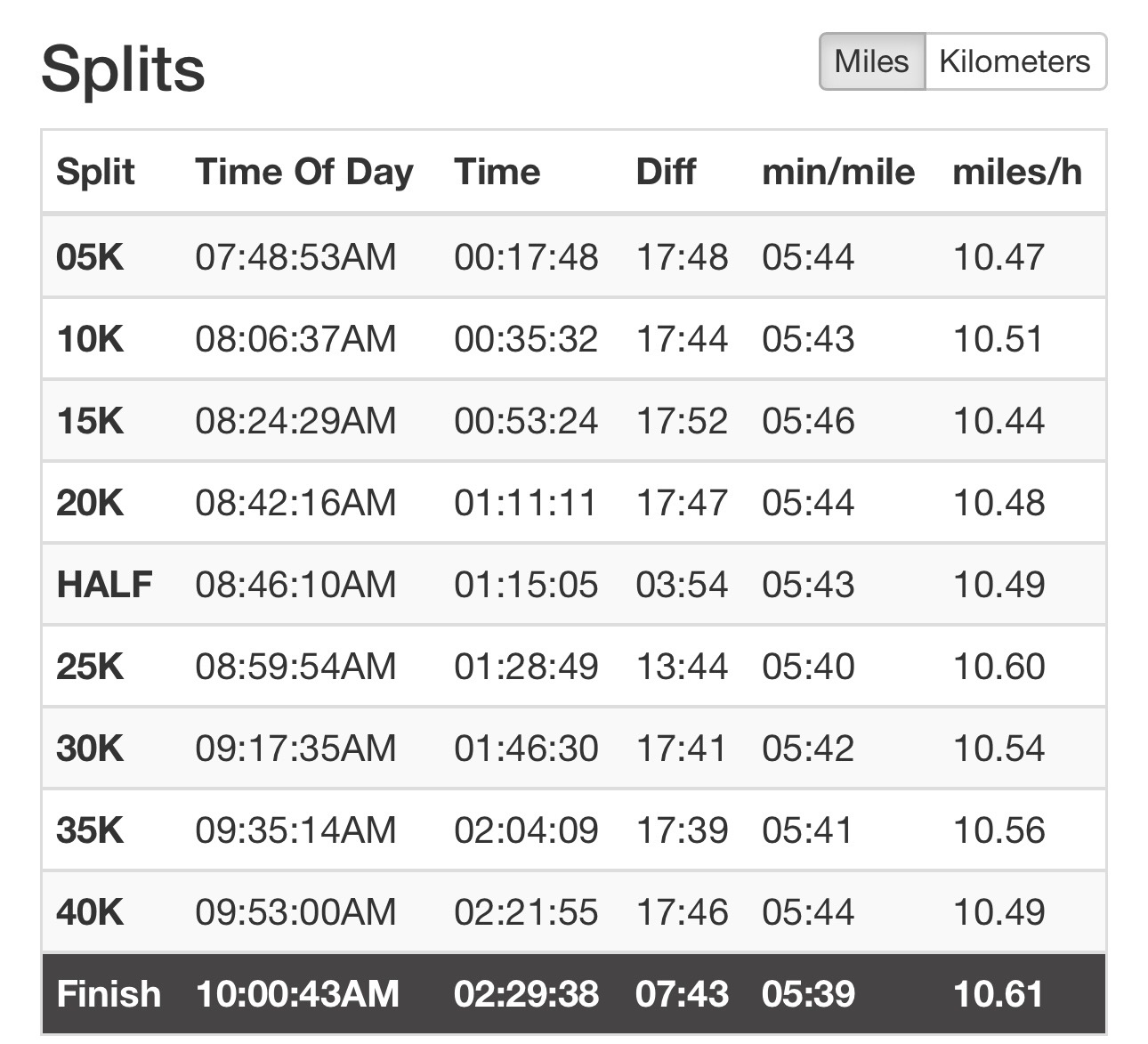
Just before the 26-mile mark we make a right turn and run up a short hill on the highway bridge before making a left towards the finish. This part of the course reminded me exactly of the Boston Marathon’s infamous finish “Right on Hereford, Left on Boylston”. I didn’t think the short hill was tough at all, but that’s likely because I still had some legs under me. After I crested the hill and made the left turn towards the finish, I checked my watch and realized that I could possibly PR by a few seconds. I made one final push on the straightaway and crossed the finish line when the clock read 2:30:38. At first, I was like “What???”, and then I remembered that I started the race a minute later than the pro/elite field. I stopped my Garmin and it read 2:29:39, so I knew I broke 2:30 and PR’d. My official time was 2:29:38, a new personal best by 10 seconds and the second time going sub 2:30, both as a master’s runner.


I was happy to have achieved my time goal of a sub 2:30 and new PR, but I was even happier when I found out I placed 2nd in the Age Group World Championships M45-49 division. As a top 3 finisher in my age group, I was invited to attend the Chicago Marathon Champions Reception later that evening.  This was an awesome experience as I was recognized and celebrated with the top performing athletes, to include the new World Marathon Record Holder Kelvin Kiptum, Sifan Hassan, Emily Sisson and Conner Mantz.  

L-R: M45-49 2nd, 1st, and F45-49 1st Place

New Marathon World Record Holder
Kelvin Kiptum, 2:00:35

I know this recap is long, but I wanted to add some final thoughts and data.

Overall, I loved the Chicago course. The course is flat and can be very fast when there is good weather, and on October 8th we had perfect weather for the marathon.  It can get very windy (I guess that’s why they call it the Windy City), but on the day the 8mph winds didn’t have much of an impact. I thought the crowd support was good.  I didn’t notice any dead spots of crowds along the course, so that was a big plus.  

I’m a big fan of running an even split or preferably a negative split race. I ran negative splits with the second half 32 seconds faster (1:15:05 / 1:14:33). Official 5k splits below.  

Nutrition: I stuck with my pre-race/raceday nutrition plan as it has worked for me in my previous marathons.  The night before the race I drank one bottle of Maurten 320 drink mix to stay hydrated and load up on more carbs.  In the morning, I had my breakfast 2.5 hours before the race and then sipped on a bottle of Maurten 320 about an hour before the race.  I took one caffeinated Maurten gel 10 minutes before the start and an additional five gels over the course of the race.  I took one gel alternating regular with caffeinated gels about every 4-5 miles (miles 4, 9, 13, 17, and 21).  In addition to the gels, I alternated drinking Gatorade and water at the aid stations. 

Shoes: Nike Alphafly Next% 2 (orange). 

Thursday, December 19, 2019

Rocket City Marathon - 2:31:04 (new PR and Guam NR)

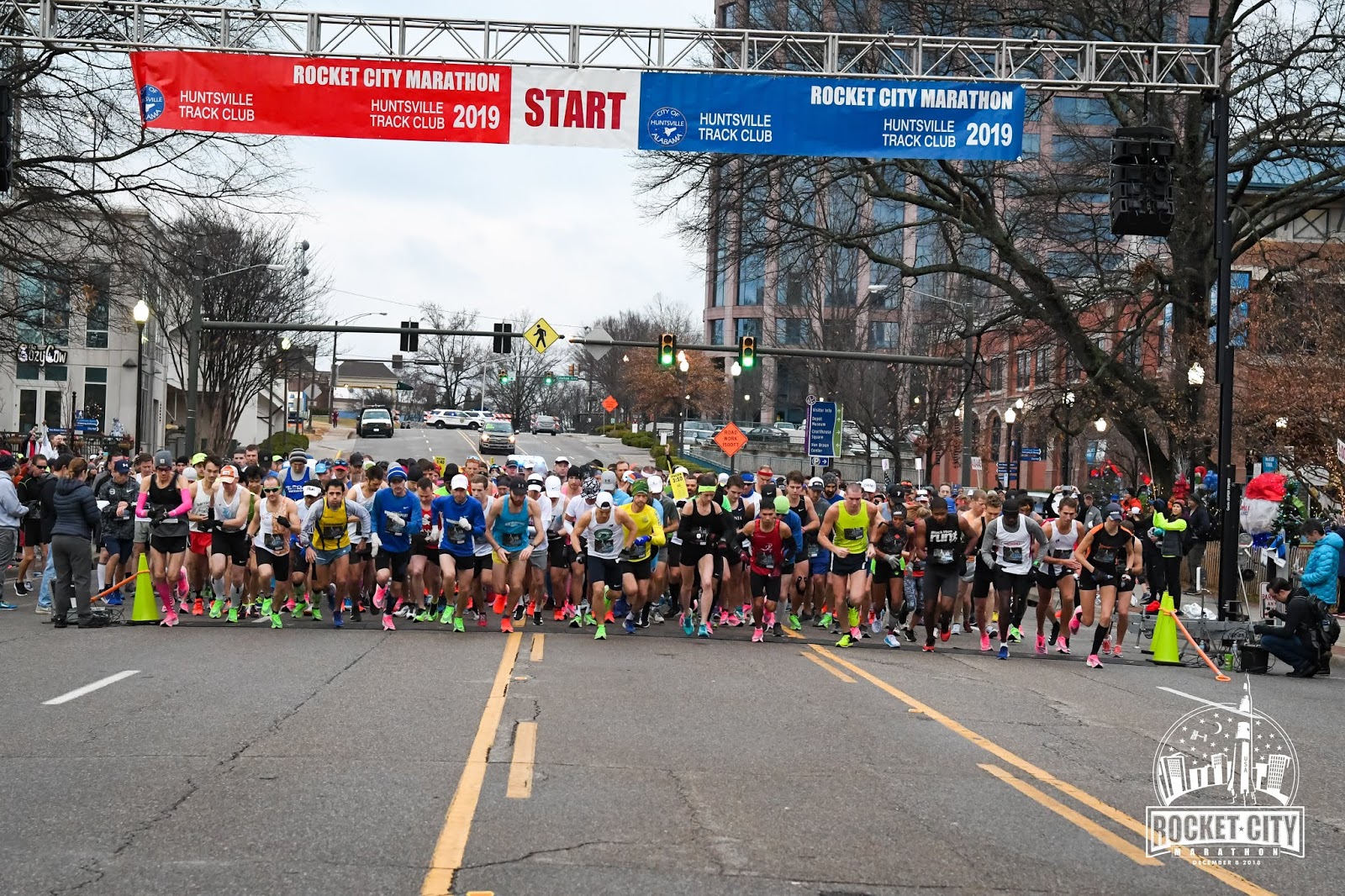
It was my second time running the Rocket City Marathon (first time was back in 2006), and my 30th total marathon.  I had originally planned to run California International Marathon (CIM), which I ran three times (2014, '15, and '18) in the last five years, but CIM was already sold out when I tried to register.  So, my other options for a late fall/early winter marathon were Indy Monumental in early November or Rocket City a month later.  Rocket City actually ended up being the only option, because Indy occurred during the same timeframe that I would be TDY (temporary duty) for work.  


I was pretty excited, but also surprisingly calm on race morning.  Not sure if I was calm because of the smaller field size (less than 2,000 runners) or because I felt fit and confident in tackling the distance.  Or maybe it was because I had gotten to the start line healthy and enjoyed the process along the way.  This alone was already a win for me.  My marathon PR going in was a 2:31:44, ran at Indy Monumental in 2016. Based on recent races and a good marathon buildup, I felt that I was ready to improve on my marathon PR.  The weather was perfect for marathon running, 43 degrees, overcast and very little wind, although it felt very windy on the long stretch to the Space Center.

The starting gun went off right at 7am and within a half mile of the race I already found myself running alone.  There was a lead group of four runners, another two runners behind the lead group, me, and then another three runners about 20 meters behind me.  Just after the Mile 2 marker, the three runners just behind (Josh, Rodney, and Martin) caught up to me.  I had no idea at the time, but the four of us were all in the Masters category.  I asked them what their goal pace or time was, but got no answer. Shortly after, Josh and Rodney picked up the pace creating a small gap that slowly increased over the course of the next 13 miles. Martin, on the other hand, dropped back a few steps, so I was running solo again.  This assembly line, Josh and Rodney running together, myself, and then Martin, remained the same from mile 3 until around mile 18.  


I felt really good in the first half, running my own pace and easily clicking off mile splits (GPS) between 5:40-5:45.  The only frustrating thing early in the race was that my Garmin watch was splitting each mile early, about 8-10 seconds before the mile markers.  The time and distance between when my watch split and when I crossed the mile markers increased as the race progressed. At first this was disturbing and had a negative impact on my mindset.  All I could think of was that I was running longer than the actual marathon distance. My inner self then told me that this was something out of my control, and that the GPS accuracy was likely off due to the frequent turns in the course.  From then on, I focused all my mental energy at the task at hand, running what felt like the right pace and effort.

I came through 10K in 35:41 and the half in 1:15:31. Just before the halfway mark, I saw my wife and she handed me my plastic water bottle I gave to her at the start. I was really glad she still had my water bottle, because I likely wasn’t taking in enough fluids early in the race.

Approaching halfway 

Miles 16 through 18 were the toughest miles. The course took us through West Huntsville on 9th Avenue and then onto Governors House Dr., which ran parallel to Interstate 565 towards the U.S. Space and Rocket Center.  The combined three mile long stretch of road was slightly uphill and rolling with noticeable headwinds.  I ran my slowest miles of the race on this section, splitting 5:50 and 5:52 (GPS) for miles 16 and 17.  On 9th Ave I saw Josh and Rodney about a minute and a half ahead.  It didn’t seem like I was closing the gap on them, but at the same time I wasn’t focus on it.  I was fixated on running my own race and ensuring that I was putting in the right effort.

Around Mile 18 at the Space Center, I noticed that I was quickly closing in on Josh.  Rodney was about 50-100 meters in front of Josh but within sight.  I caught and passed Josh right after the 19.4 mile aid station.  About a half mile later I shot by Rodney as we headed into the Huntsville Botanical Garden. I couldn’t believe how good I was feeling with 10k to go.  There’s a saying that the marathon is broken down into two races, a 20 mile long run and a 10k race.  This couldn’t be truer, and at 20 miles I felt like the race was just getting started.  Just before I exited the gardens I was surprised to see and overtake another Masters runner (Dancan).  Didn’t know he was a Masters runner until after I viewed results.

After meandering through the botanical gardens, the course took us back onto 9th Ave for miles 23 through 24.5.  I was now running in the opposite direction of the other runners heading out to the Space Center.  This was nice because all the runners were cheering me on.  One runner yelled out that I was currently in 4th place and that 3rd place was not far ahead.  I overtook the runner in 3rd and kept that position until the finish.  I later found out that the 3rd place guy I overtook (Chris) was trying for the Olympic Trials Qualifying (OTQ) time of 2:19, but fell off pace.

At mile 25.2, a race timer yelled out “one mile to go” and the time “2:25:25”.  Until this point, I really had no idea of my estimated finishing time except that I was somewhere in the 2:31 range.  After some quick calculation, I realized that I needed to run just under a 5:35 last mile or faster to go sub-2:31.  I knew that a 5:35 mile was doable, but it wasn’t going to be easy.  With about a quarter mile to go, I ran by my wife along Big Springs Park and she yelled for me to “push it all the way to the end!” I think she knew that I was cutting it very close to breaking 2:31. The marathon finishes inside the Von Braun Center and when I made the turn into the arena, I saw the clock just about to turn over from 2:30:5x to 2:31:00. Unfortunately, I came up short of becoming a 2:30 marathoner by 4 seconds.  I crossed the finish in 3rd Place Overall and 1st Masters with a chip time of 2:31:04, a new PR and Guam National Record by 40 seconds.  Results are here.

Pushed it all the way to the end!
I was excited to have just run a new PR, but even more excited with the way I executed my race.  My half splits were 1:15:31 and 1:15:33.  The last 10k was by far the best finish I’ve had in any my 30 marathons.  I averaged 5:37 pace (based on GPS splits) for the last 7 miles (mile 20 to 26).  I told my wife afterwards that I felt like my race was worth a sub-2:30 performance.  Interestingly, my Garmin watch, as well both of the top two finisher’s watches, measured the course at 26.55 miles, which if true is equivalent to a 5:41 average pace and 2:29:11 estimated marathon effort.  The reality though is that official results are what counts.  I ran 2:31:04 on a certified course and super proud of it.


Mile Splits (GPS)

Okay, I should end this race report, but before I do so I want to note a couple things.

  • Nutrition.  I didn’t talk about nutrition in my write up, but here’s what I did.  I took one Maurten gel just before the start, and an additional five gels over the course of the race (miles 6, 12, 16.4, 19.4, and 23).  I felt that my nutrition was spot on!  On the hydration side, I think it was fine.  I took in fluids at every aid station except one, which I missed (not intentionally).

  • Masters Running (40 yrs and over).  There were some very good Masters runners at the 43rd Rocket City Marathon.  The title for Top Masters and $750 was very competitive, and I was really proud to come out on top.  It’s crazy that six of the top nine finishers were Masters runners.  It just goes to show that age is just a number! Also in addition to the $750, I also won an additional $500 for 3rd Place Overall.  Combined I took home more $$ than the overall winner! 
RCM Male Masters Champion
and Finisher’s Medal


Tuesday, November 08, 2016

Indianapolis Monumental Marathon

The Indianapolis Monumental Marathon was my 26th race at the 26.2 mile distance. As a countdown to my 26th marathon, I posted a photo each day on Instagram of my previous marathons (1-25) with my result and a brief description of the race. It was pretty interesting to see my marathon progression over the years.  If you have some time, be sure to check it out on my Instagram (click here). 
 

I decided to run Indy Monumental for a couple reasons: (1) my coach had recommended the race; (2) I wanted to run a course that was mostly flat and fast. The last two years I ran Boston and California International Marathon, both of which are rolling hill courses;  And (3) I qualified as an elite athlete and would get a comp entry.

I arrived in Indy on Thursday and after stopping by the expo to pick up my bib, I enjoyed a nice birthday dinner date with my wife. I turned 39 years young two days before the race. On Friday, besides a pre-race shakeout run in the morning and then brunch with my wife in downtown Indy, I didn’t do much of anything. I stayed off my feet as much as possible. I waited till the late afternoon for the elite athletes’ meeting, where we would receive some instructions and drop off my fuel bottles for the race. I dropped off three Herbalife24 water bottles filled with a mixture of Herbalife24 Prolong and Prepare. My green bottles would be easily identifiable, because all the other bottles were clear with markings on them. 
 
Prepping my fuel bottles with Herbalife24 Prolong/Prepare

After the meeting my wife and I met up with Scott (my coach), Joseph Alsakr (who was running the half), Joseph’s friend, and another of Scott’s athlete for dinner. We ordered some take out pasta, found an area with tables and chairs in the Circle Center Mall, and carbo loaded. I thought this was a brilliant idea. We didn’t have to decide on a restaurant, and even if we did we'd probably have to wait a half hour for our food. 

Race
My race plan was similar to my last CIM race, go out at 5:43-5:45 pace for the first half (1:15ish) and then try to negative split the 2nd half. When the gun went off, everyone shot off. The half-marathoners started at the same time as the marathoners, so there was no way of telling who was running the marathon until the half-marathoners split off just after mile 7. In the first mile, my GPS was reading 5:45 pace, so I figured I was running the right pace. When my watch automatically split at 5:45, there was no mile marker in sight. I got to the 2nd mile marker and the clock read 11:17. It turned out that I likely ran the first mile in around 5:35. I didn’t want to run any faster than 5:43s, and Scott said that it’s easy to get sucked into running a faster pace with the half-marathoners, so I slowed the pace a tad bit. Around mile 4, three runners (from here on out I’ll refer to them as the small group) came up beside me. I heard one runner say that his plan was to run the first half in 1:15 and the second half in 1:15. I said “Awesome, I’m also aiming for 2:30.” Not long after I said that, the group kept on rolling and immediately put about 10 meters on me. I was confused because I felt like I was running 2:30 pace and here they were rolling on by. I decided not to go with them and continued running my pace. (Turned out it was the right decision). I came through the 10k in 35:34, right on 5:43 pace. The small group went through 20 seconds faster.

Just after the half-marathoners broke off around mile 7, one runner (Shawn Ferguson) came from behind me. I ran with Shawn for about a minute and then backed off as I felt like he was running about a 5:40 pace. At mile 8, I saw the first fuel table and I had no problems spotting my green Herbalife24 bottle. I held on to my bottle for about a quarter mile until I took in most of my fluids (about 10 ounces). Over the next few miles, I continued to run alone with Shawn about 100m ahead and the small group about another 100m in front of Shawn. I came through the half in 1:15:15, right about where I wanted to be. Looking at the results, Shawn came through the half in 1:14:55 and the small group in 1:14:22, sub-2:29 pace. I knew the small group was running faster than 2:30 pace.

At 14 miles, I picked up my second fuel bottle. I carried it until I took in all my fluids. I continued to feel pretty good running anywhere between 5:43-5:46 pace. At around 17 miles into the race, my GPS acted really weird. It showed that I was running 7:50 pace, and then it would jump down to 4:40 pace. I decided to stop looking at my watch and just focus on running by effort.   

Just before mile 20, I started to feel a little cramp developing in my left hamstring.   I experienced this in previous marathons and learned that I just needed to take in more fluids and an energy gel.   Luckily, the third and final fuel station for elites was at 20 miles.   I picked up my last fuel bottle and drank every ounce of it.  The cramp subsided, but my pace had slowed into the 5:50s.  

During the long stretch of road on mile 22, I caught and passed each of the runners from the small group.  Two of the runners from the small group ended up running the 2nd half four minutes slower while the third runner ran seven minutes slower.  I was glad that I stuck with my own pace early in the race. 

Around midway through 24 miles, the marathoners and half-marathoners merge onto the same road.  Traffic cones separated the two races, but there were still half-marathoners who thought it was cool to run on the marathoners' side of the road.  About 24.5 miles, one marathon runner (Jake Sutton) came from behind and caught me.  Jake shouted to the half-marathoners in our lane to make a hole.  I didn't have the energy to say anything and probably would have just gone around the half-marathoners.  Jake clearly had something left in the tank because his turnover was a lot quicker than mine.  I tried to go with Jake, but I just couldn't hang on to him.  It was the first time being passed by another marathoner since mile 7.  Jake ended up running a really smart race and huge negative split (1:16:31 / 1:14:53).

Jake behind me in yellow/red singlet about to put a whooping on me!

The last half mile of the Indy Monumental course runs by the Indiana state capitol building before making a sharp right to the finish near the Government Center.  When I hit the 26 mile marker by the state capitol in 2:30:30, I realized that I could still PR if I booked it in.  I then shifted into another gear and crossed the finish in 2:31:44, a new personal best by 10 seconds.  I placed 11th Overall and was 1st in my Age Group. 

Overall, I was pretty ecstatic to PR, because honestly I thought I had lost too much time between miles 21-25.  I was a little bummed, however, that I didn't run 2:30/sub-2:30.   At 39 years young and approaching the Masters division, I still think that I have a 2:30/sub-2:30 in me.  We will see! 
 
11th Overall, 1st in Age Group


Nutrition
Pre-race: The morning of the race I had a bagel with peanut butter and jelly, a Herbalife24 Formula1 Sport shake and a banana.  I also drank 20 ounces of Herbalife24 Prolong a couple hours before the race.  Normally, I drink a cup of coffee, but I didn't this time around because my tummy was already full, and I wanted to ensure I took in electrolytes before the coffee.  Right before the race started, I took in one energy gel. 

During the race: At miles 8, 14 and 20, I took in about 10-12 ounces of Herbalife24 Prolong mixed with a little Prepare.  I also took in 3-4 gels throughout the race.  

Sunday, May 08, 2016

2016 Boston Marathon Race Report

This race report is long overdue, but it's better late than never.  

Marathon Training
My Boston Marathon training went really well and I felt like I was in slightly better shape than I was going into CIM where I ran 2:31:54.  Although training went well, I was a little stressed in January/February.  I made the temporary move from Maryland to Tampa for work, and leaving the family behind was tough.  One might think that Tampa is a great place to train for a marathon in the late winter and early spring, but not quite.  While the temperatures (60-70 deg) were ideal, it was the high humidity that made training sometimes very tough.  Additionally, Tampa is pancake flat and probably not the best place to train if you're preparing for a marathon with lots of rolling hills like Boston.  Believe it or not, I had to drive 1.5 hours to Clermont, FL to put in a long run on rolling hills.  With the exception of one long run on rolling hills, all of my training runs from Jan 30 - Apr 14 were done on flat surface.  Pathetic!


Tampa is flat! I had many weeks with 0 ft elevation gain.
Race Strategy
My race strategy going into Boston was to run 5:45ish pace and feel comfortable up to Newton Hills.  I'd expect my pace to slow around 5:50-5:55ish on the hills and then hopefully run strong over the last five miles.  The plan was to come through the half between 1:15-1:16, which would put me in a good position to finish hopefully somewhere between 2:30 and sub-2:33.  

Boston Marathon
There are many things that make the Boston Marathon a unique race.  It's the world's oldest annual marathon and ranks as one of the world's best-known road racing events.  Runners must meet the Boston qualifying standards (aka BQ), and even with a BQ you're not guaranteed an entry. For 2016, runners had to run 2 minutes and 28 seconds faster than their age and gender standard. Also, the rolling hills course is brutal and will thrash the legs before you get to the actual hills. Let's not forget the Boston Strong crowd.  Boston's crowd support along the 26.2 mile course is unlike any other marathon.  There are thousands of Boston spectators lining the course to cheer on and encourage the runners, regardless of the weather conditions.  Speaking of weather, I think this is what makes the Boston Marathon a unique and unpredictable race. The weather on Patriot's Day can be cold, hot, rainy, or very windy.  In my last five Boston Marathons, race day conditions varied: 2012 was scorching with temps in the high 80s, 2013 and 2014 were almost perfect marathon weather, and 2015 was cold and wet with strong headwinds.  This year the conditions looked perfect for marathon running about 7 days out from the race.  However, as it got closer to race day, it seemed as though it was going to be another warm Marathon Monday.  


Race
The temperature at the start of the race was in the low to mid 60s, but it felt a little warmer with the sun beating down and no cloud cover.  Since I've been training in warm and humid conditions over the last couple months, I decided to stick with my race strategy.  The gun went off and I tried to focus on running smooth and comfortable as much as possible.  The first few miles were slightly faster than 5:45 pace, but with the early downhill miles I expected that I'd be closer to 5:40s.  From mile 5 till the halfway mark I settled in running splits between 5:45 - 5:50.  I took in fluids at every aid station and an energy gel every 5-6 miles.  

I came through the half in 1:15:35, which was right where I wanted to be and on pace for a sub 2:32.  At this point in the race, not only was it very warm, but there was also a decent headwind.  The headwind wasn't as strong as last year, but it was noticeable and enough to slow a runner's pace a few seconds per mile.  After running 5:48 and 5:50 for miles 14 and 15, I opened up on the last half mile of mile 16, which had a 130 ft elevation loss, and ran a 5:32 mile split.  I did not expect to run the mile split that fast.  I'm not sure if it was the fast 16th mile split or the warm weather and grueling downhills, or a combination of all of it, that took something out of the legs because they started to feel heavy.  


In the Newton hills, my pace began to slow and I could only manage to run 6:02, 6:09 and 6:06 for miles 17-19.  I calculated that I'd finish with a sub 2:35 if I maintained my current pace.  My hamstrings then started to cramp a little around Heartbreak Hill and now my race went from feeling tough to survival mode.  Instead of running 6:05-6:10 pace I was now running 6:30 pace.  I tried to stay composed and took in as much fluids as I could at the aid station to prevent the hamstrings from cramping even more.

Deja-vu
At around the Boston College campus on Commonwealth Ave, I caught up to a runner that looked familiar.  It was the BAA runner (Brad Mish), who I came across around the same part of the course in last year's Boston Marathon.  It was like deja-vu all over again.  What's bizarre about it, and I didn't know it until I saw the photos, is that we were both assigned the same bib numbers for the 2015 and 2016 race.  
The BAA runner looked familiar!
After I caught up to Mr. 982, we ran together for a little bit before he slowly faded back.  At this point in the race, my legs couldn't go any faster, and I was just trying to hold things together and get to the finish line in one piece.  Luckily, my legs held up and I was able to run no slower than 6:30 pace over the last 10K.  I crossed the finish in 2:37:23, which was good enough for 90th Overall.  


After-thoughts
All in all, I was satisfied with my race performance and that I ran tough when the going got tough.  I was most happy with finishing in the Top 100 again (56th Overall in 2012).  I think finishing in the top 100 in any of the six World Marathon Majors ((Tokyo, London, Boston, Berlin, Chicago, New York) is a significant accomplishment for an average runner.  Although I know I was fit and ready to beat last year's time, I think the warm conditions and lack of hill training were factors for the slower finishing time.  Unfortunately, there's nothing I could have done about the weather on Marathon Monday and the lack of hills in Tampa.   Life goes on....

What's next?
I normally take a full recovery following the Boston Marathon and then slowly build my base back up during the summer.  However, this time around I'm only taking a few weeks to recover from Boston before I'm back training hard again.  There's a "possibility" that I may represent my island of Guam in the 2016 Olympic Games marathon in August. I likely won't know if I'm selected or not until early July.  While July is late notice, the only thing I can do is train my butt off, get into the best possible shape and hope I'm selected.  Wish me luck!!!


Completing the Rio nomination packet

Saturday, April 23, 2016

120th Boston Marathon - 2:37:23, 90th Overall

I ran my sixth Boston Marathon (5th consecutive) this past Monday finishing in 2:37:23, 90th Place Overall.  While my time was much slower than I had hoped, I was still very happy to have placed in the Top 100 for the second time (I was 56th Overall in 2012).  


The finishing times were slower across the board, even for the elites, because of the warm and windy conditions.  I'll get more into the details in my race report, which I hope to post soon.  

Thursday, October 22, 2015

Marathon Results and Statistics


#
Marathon
Date
Time
Pace
1st Half
2nd Half
Place
1 Marine Corps 10/26/2003 2:52:22 6:37 1:22:46 1:30:36 47
2 Honolulu 12/14/2003 3:09:38 7:14 176
3 Boston 4/19/2004 2:59:23 6:51 1:24:39 1:34:33 307
4 Houston 1/16/2005 2:42:14 6:12 1:21:11 1:21:03 25
5 Marine Corps 10/30/2005 2:41:15 6:09 1:20:16 1:20:59 35
6 Austin 2/19/2006 2:38:16 6:02 1:19:17 1:18:59 54
7 Rocket City 12/9/2006 2:39:21 6:05 1:18:29 1:20:52 9
8 Grandmas 6/21/2008 2:54:08 6:39 1:25:23 1:28:45 80
9 Amsterdam 10/19/2008 2:35:37 5:56 1:17:34 1:18:03 43
10 Hamburg 4/26/2009 2:34:33 5:54 1:17:16 1:17:17 36
11 Berlin 9/20/2009 2:34:06 5:53 1:16:20 1:17:46 98
12 Marine Corps 10/25/2009 2:41:33 6:10 1:17:16 1:24:17 34
13 Rotterdam 4/11/2010 2:35:46 5:57 1:17:04 1:18:42 73
14 Munich 10/10/2010 2:33:50 5:52 1:16:46 1:17:04 9
15 Rotterdam 4/10/2011 2:35:26 5:56 1:16:32 1:18:54 67
16 Boston 4/16/2012 2:36:35 5:59 1:18:29 1:18:06 56
17 Boston 4/15/2013 2:36:49 5:59 1:17:08 1:19:41 179
18 Big Sur 4/28/2013 2:46:05 6:20 1:23:08 1:22:57 11
19 Richmond 11/16/2013 2:36:44 5:59 1:17:27 1:19:18 12
20 Boston 4/21/2014 2:53:34 6:37 1:17:24 1:36:10 1310
21 All-American 5/4/2014 2:48:03 6:25 1:20:37 1:27:26 3
22 California Int'l12/7/20142:32:295:491:16:411:15:4865
23 Boston 4/20/2015 2:33:13 5:51 1:16:13 1:17:00 119
24 California Int'l12/6/20152:31:545:481:15:121:16:42 44 
25 Boston4/18/20162:37:236:001:15:351:21:4890 
26 Indy Monumental11/5/20162:31:445:471:15:151:16:3011 
27 Boston 4/17/2017 2:34:49 5:54 1:16:14 1:18:35 97
28 Boston 4/16/2018 DNF


29 California Int’l 12/2/2018 2:32:16 5:49 1:14:57 1:17:19 186
Average 2:40:43 6:08 

Facts and statistics in no particular order.
  • New Marathon Personal Best is 2:31:44 at the 2016 Indianapolis Monumental Marathon
    • Ran my PR on my 26th marathon at the age of 39!
    • My four fastest marathon times were ran in the last two years (2014-2016).
  • Boston Marathon
    • 6 total Boston Marathons
    • Ongoing streak of 5 consecutive Boston's (2012-2016)
    • Placed 119th Overall in the 119th edition of the Boston Marathon (2015)
    • Placed in the Top 100 in 2012 and 2016. 
      • 56th Overall in the 2012 scorching heat.
      • 90th Overall in 2016; very warm and windy.
  • 3rd Place Overall in Boston2BigSur Challenge (2 marathons in 13 days)
  • Average marathon time and pace for my 25 marathons is 2:41:39 / 6:10 pace.
  • Ran 15 marathons in the 2:30's (between 2:30:00 to 2:39:59), 5 marathons in the 2:40's, 4 marathons in the 2:50s, and 1 marathon over 3:00 (decided to run Honolulu last minute as a fun run while on vacation). 
  • Ran 12 marathons at sub-6:00 pace or sub-2:37:12.
  • 6 marathons with a negative or even split halves.  I'm considering Hamburg Marathon an even split race since I was only 1 second slower in the 2nd half. 
  • 10 marathons were within 1-3 minutes slower in the 2nd half. According to this RunningTrainingTips article, a slight slow down of 1-3 minutes in the 2nd half is considered good marathon pace judgement. 
  • Ran 6 marathons in Europe: 3 in Germany and 3 in the Netherlands. 
    • Avg finish time and pace for European marathons is 2:34:53 / 5:55 pace.
    • Is European's pavement better than the US for running or are the courses just faster?
  • Since 2003 I ran at least one marathon each year except for 2007 (deployment to Iraq).
  • I ran 4 marathons 2 or more times - 6 x Boston, 3 x Marine Corps, 2 x Rotterdam, 2 x CIM
  • The most marathons I ran in one calendar year is 3 in 2009.  
  • 5 - # of times I hit the "Wall" in the marathon.
    • Marine Corps '03 - what better way to experience the wall than in your 1st marathon.
    • Boston '04 - HOT! 2nd hottest Boston Marathon in history at the time. (can't use the heat as an excuse since I ran well in '12 Boston when it was hot again)
    • Marine Corps '09 - Ran MCM only 5 weeks after Berlin.  
    • Boston '14 - you can't expect to run well in Boston if you don't train on hills.
    • All-American - cramped badly at 20 miles, but still fought hard for 3rd Place.
  • 2:54 at Grandmas Marathon - still decided to run Grandmas after only 4-5 weeks of training; had IT band syndrome that lasted for 8 weeks.

Thursday, December 11, 2014

California International Marathon (CIM)

I was really looking forward to CIM. I had an excellent build up, trained hard and was eager to redeem myself after a couple sub-par marathons earlier this year. My 1:13 Philly half-marathon in September followed by five solid weeks of moderate altitude training in El Paso indicated I was fit and ready to run close to or faster than my personal best. My main goal entering this race was to run 2:35 or better, which I haven't done in over 3 years. However, in the back of my mind, I truly wanted to run a new marathon personal best. CIM was the right marathon to take a shot at a new marathon PR because of its fast course (but not easy) and the depth of runners in the 2:30s. 


I woke up at 4am and went downstairs to the hotel dining area for breakfast. I had my usual pre-race meal: a bagel with peanut butter and jelly, yogurt, banana, Herbalife24 Formula 1 Sport shake and a cup of coffee. An hour later I hopped on the runners' shuttle bus to Folsom. When we got to Folsom I remained on the bus to stay warm and hydrated with Herbalife24 Prolong. About 30 minutes before the start I went for a mile jog, did some strides and then headed to the start line. At the start I lined up about five rows back so I wouldn't take off like I was running a 5K. 


When the race started I slowly settled into what felt like marathon pace/effort, around 5:50-5:55 pace. About a mile into the race, I found myself running alongside a pack of about 8-10 girls.  I'm sure the girls were all aiming for the US Olympic Marathon Trials A (2:37) or B (2:43) Standard. I asked the guy leading the pack what pace he was running, and he responded with 2:37 and that he was running the entire marathon. I was actually surprised because we had split Mile 1 at 5:52, which in my mind was a little too fast for a 2:37 marathon. The pacer might have realized it because I didn't see him or the pack of girls shortly after. (I later read that a total of 20 US women and 10 men qualified for the 2016 Olympics Marathon Trials.)

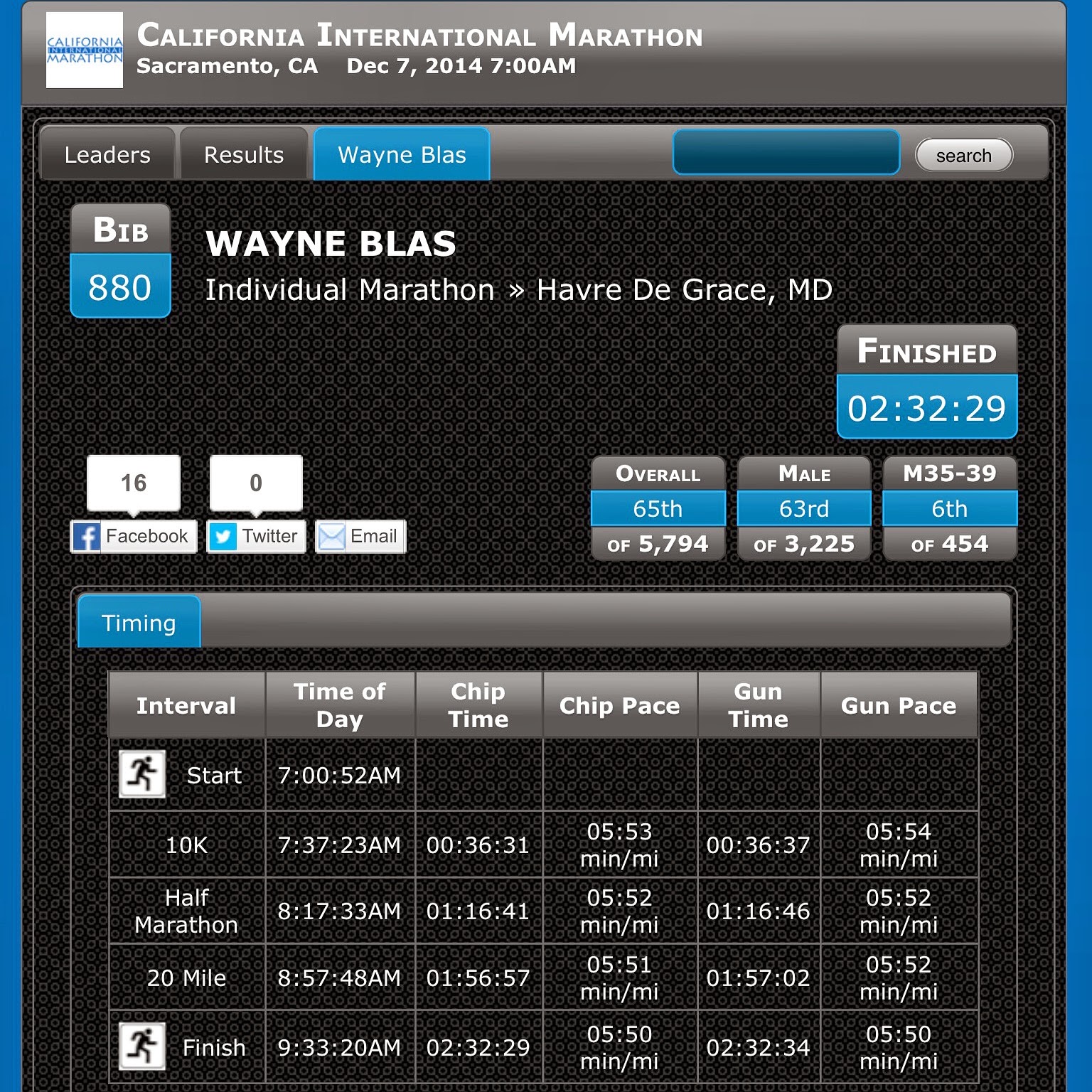
I clicked off mostly 5:52's for the first 6 miles (5:52, 5:53, 5:49, 5:52, 5:49, and 5:52) feeling comfortable and smooth.  At 4 miles I was 10 meters behind a pack of about 12 runners which was being led by Michael Wardian.  Mike had competed in the North Face Endurance 50-miler in San Francisco the day before. I'm not sure if he even had time to clean up after the 50-miler.  The guy's a Beast!  I thought about putting in a surge to catch up to the pack, but decided not to since I was more focused on running my own race.  It was the right decision because within a few miles after the 10K mark, which I crossed in 36:31, the pack began to string out and I eventually overtook most of the runners with the exception of Mike and a couple other guys. I took my first gel at 5.5 miles.

I hit the half-marathon mark in 1:16:41 still feeling great.  The hills in the first half were noticeable, but not steep or long enough to break up my rhythm. The hill I remember most was the semi steep hill on Sunrise Blvd around 10.5 miles.  The steep hill is part of the San Juan Hills which rolls from miles 10.5 to 13.  Approaching Sunrise Blvd we ran ran downhill and then climbed a hill that was about a 1/4 mile long.  I think my strong hill running ability showed here because I ran splits of 5:47, 5:48 and 5:51 on the San Juan Hills (11-13 miles).  I was well prepared for the hills and the rolling course because 1) my coach (Scott) put together a solid training schedule that incorporated some intense training on rolling terrain, and 2) I trained on hills that were steeper in grade and longer than the CIM hills.  I took my second gel at the 13 mile mark. Splits for Miles 7-13 were: 5:52, 5:56, 5:54, 5:47, 5:47, 5:48, and 5:51.  


Miles 14-20 were uneventful.  I continued to throw down splits between 5:47-5:53 (5:53, 5:53, 5:48, 5:52, 5:51, 5:43, and 5:50).  During this stretch of the race I took in a gel at miles 16.5 and 19.4.  At Mile 20 (1:56:57 - 5:51 pace), I was still feeling good, but was a little worried I'd suddenly encounter a cramp in my legs.  In my last two marathons (2014 Boston Marathon and All-American Marathon), I cramped badly between 18-20 miles and suffered through the last 10K of those races.  I didn't want to experience the suffering again.  

Around Mile 21, I passed the women's pre-race favorite and 2:27 marathoner, Renee Metivier Baillie.  I was surprised and felt bad to see Renee, because she was hoping to take down the 2:29 course record and was obviously not having a good day.  Shortly after passing Renee I had a little scare.  I felt a minor twinge on my left hamstring, almost as if a cramp was about to happen.  To fight off the developing cramp, I took in my last gel (carried 5 with me) and some Nuun, an electrolyte drink offered on the course.    The gel and electrolytes must have helped because I didn't break a stride and ran splits of 5:48 and 5:49 for Miles 21 and 22.  On the 23rd mile, I felt another twinge on the same spot.  Luckily, there was an aid station at 23.5 miles that offered GU.  I took a GU and drank two cups of Nuun at the aid station.  The fuel must have worked again because I ran 5:43 and 5:48 for Miles 23 and 24.  I don't know what flavor of GU it was, but it didn't taste all that good and I really didn't care.  I just didn't want to cramp this late in the race when I was on pace to run a PR.
  
With only a couple more miles to go, I kept telling myself to relax and stay focus.  Around Mile 25, I caught up to Mike Wardian and briefly chatted with him.  For some reason, seeing and catching up to Mike gave me a boost of confidence.  I told Mike that I was having a good race and was on pace to run a PR.  He told me to Go Get It!  Mike finished in an impressive 2:33 following a 50-miler. Impressive!  Mile 25 was a 5:48. In the last mile, I pretty much gave it my all.  With about a half mile to the finish, I passed the 3rd place female, Kristen Zaitz, and was closing in on the 2nd place female, Jane Kibii.  Unfortunately, I ran out of real estate and could not overtake Jane.  My Mile 26 split (5:33) was the fastest split of the race.  


The CIM Finish can be heart-breaking to runners because you can't see the finish line from 8th St.  It's not until runners make the turn onto Capitol Mall that they'll see the finish about 50 meters ahead.  When I turned onto Capitol Mall I saw the clock read 2:32:xx.  I was so happy I started celebrating by throwing fist pumps in the air as I approached the finish.  I crossed the finish with an official time of 2:32:29, a personal best by 1:21.  


CIM Finish.

As my coach said, I ran this race like a pro.  I've ran negative splits for the marathon a few times, but I've never ran almost a minute faster for the 2nd half.  I ran the 1st and 2nd halves of the race in 1:16:41 and 1:15:48, a 53 second negative split.  I also ran the last 10K of the race in 35:32 (5:44 pace), which is the fastest 10K split in all of my marathons.  Below are my official splits and GPS splits:


Mile  Split
1       5:52
2       5:53
3       5:49
4       5:52
5       5:49
6       5:52
7       5:52
8       5:56
9       5:54
10     5:47
11     5:47
12     5:48
13     5:51
14     5:53
15     5:53
16     5:48
17     5:52
18     5:51
19     5:43
20     5:50
21     5:49
22     5:50
23     5:47
24     5:43
25     5:48
26     5:33