Showing posts with label California International Marathon (CIM). Show all posts

Friday, December 11, 2015

California International Marathon - 2:31:54 (PR)

“What comes around goes around.”  A couple weeks out from the marathon my daughter caught a cold.  It wasn't that bad and within a few days the cold was gone, but not until she passed it to her mom.  You know where this is going.  On Monday of race week I picked up the cold from my wife.  At first, I didn’t think much of it and thought that it wouldn't get any worse, but by Wednesday I had a nasal congestion and a minor sore throat.  I tried everything in my power to fight off or shorten the cold during the rest of the week.  I drank plenty of fluids, continued to take my vitamins (C), took an extra dose or two of DayQuil, and went through a box of tissues.  By Saturday I was feeling better or at least that’s what I kept telling myself.  Just as I was getting over my cold, my daughter caught it again. 


My race strategy going into CIM was to run 5:43-5:45 for the first half and then hopefully pick it up and negative split the second half, just as I did in last year’s race.  If I execute this plan perfectly then there is a very good chance I’ll achieve both of my goals: (1) run a new PR, and (2) break 2:30 for the marathon.  Since I felt that my cold was almost gone, I decided to stick with my race strategy.


Just before the race started it began to rain.  Fortunately, it was light rain and the temperature only in the low-50s with little wind.  Any colder and windier and I would have felt like I was running in the 2015 Boston Marathon.  Personally, I thought the conditions were “almost perfect” for marathon running.  My only wish was that it didn't rain.  With the roads wet, I felt like I wasn't getting good traction or push off with my Saucony Type A6. 

I felt really good and comfortable early in the race clicking off mile splits mostly in the range of 5:43-5:46.  The first mile, which was mostly downhill, was 5:41 and on the fast end of MP.  Somewhere in the first mile my friend (who I haven’t met in person until now) and former Guam resident Johnson Lee pulled alongside me.  Johnson, who lived on Guam until he moved stateside to attend college, ran cross country and track for the University of Portland and holds the Guam 10,000m record.   We chatted a little and he asked me what time I was planning to run.   I told him that I was hoping to break 2:30.  I think after I told him that he backed off on the pace as he was aiming for 2:33.  Although the first mile felt very easy, I also backed off a little on the pace and settled in at my planned pace for the first half. 

The 2:30 range can be a lonely pace in a lot of marathons.  I was glad that within a couple miles into the race I had the company of Scott Trummer and Justus Meyer.  Scott shared that he was planning to go through the first half around 1:15:30 and then negative split the second half and hopefully dip under 2:30.  I told him that I had the same plan except that I wanted to be closer to 1:15:10 at the half, so I wouldn’t leave too much time to make up on the back half. 

We cruised along averaging right around 5:45 pace for the first 8 miles.  Scott and I came through 10K in 35:55 with Justus a couple seconds behind us.  Around mile 9, Scott put in a surge and immediately gapped Justus and I by about 20 meters.  I chose not to go with Scott, because I wanted to stick with my plan of running my own race.  Additionally, I was already running my planned 5:43-5:45 pace, and putting in a surge with 17 miles still left in the race most likely would have come back to bite me in the rear. 

Around 10 miles I started to get worried because my left hamstring was feeling tight.  It was almost as if a knot was developing in my left hammy.  I’m not sure if the rolling hills early in the race started to take its toll or if I wasn’t taking in enough fluids.  I know it wasn’t the latter because I was drinking at almost every aid station and even took in an energy gel right before the race and at 5.5 miles.  I tried hard not to think of it and continued on with my pace. 

One thing worth sharing is that shortly after the 10 mile mark, I caught up to one of the blind athletes.  Blind or visually impaired athletes started 5 minutes ahead of the main field and were running CIM as part of the US Association of Blind Athletes (USABA) Marathon National Championships.  When I caught up to the blind athlete (Matthew Oliver) I was surprised and caught off guard when he turned to me and asked where we were at in the race.  My thought at the time was where was his guide and how did he get this far without one?  I told him that we had just passed the 10 mile mark and then wished him luck and continued with my race.  It wasn’t until I read this article on USABA that I learned Oliver’s first guide could not keep up with the 6:21 pace he was running.  Wow, impressive!  According to the article, Oliver continued to run without his first guide and just followed random people; I guess I was one of them.  Oliver finished in a blazing 2:50:41 winning the USABA National Marathon Championships. 


Oliver running with his second guide
Photo from USABA website
Despite a tight left hamstring, I split the next four miles (10-13) in 5:41, 5:44, 5:41 and 5:42.  Justus and I both came through the half-marathon mark in 1:15:12, exactly where I wanted to be with my plan to negative split.   Scott, on the other hand, was about 10 seconds in front of us, but seemed to be slowly coming back to us.  Right when we hit the Mile 16 marker Justus turned to me and said “the fun part begins”.  I knew exactly what he meant. 

Justus and I ran together for the next few miles at around 5:45 pace until about 19 miles, when he slowly pulled away as my pace slowed.  Shortly after, I caught Scott just before the 20 mile mark and encouraged him to go with me. He tucked in behind me for about a minute before slowly fading back.  I split miles 19/20 in 5:48 and 5:54 respectively.  Any thought of breaking 2:30 was thrown out the window.  I now had to focus on holding things together if I wanted to run a PR.  In a marathon, time adds up very quickly when you’re running 10-15 seconds/mile or slower than your goal pace. 

My left hamstring at this point of the race was getting tighter and tighter, and I was afraid that I would cramp up at any moment.  I even considered stopping to massage it, but then I knew I would lose too much time.  Once you stop in a marathon, it's almost impossible to start back up at the pace you were running.  My pace continued to slow over the next couple miles.  I ran 6:00 and 6:02 for miles 21 and 22, which were my slowest miles of the race.  Knowing that a PR was in jeopardy, I regrouped and psyched myself into finishing the race strong.  I ran 5:51, 5:58 and 5:51 for miles 23-25.  I probably would have ran a 5:51 split for mile 24 if I didn’t scuffle with the Gu.  I know it seems too late in the race to take a Gu, but I went ahead and took it because I was following the same nutrition plan as last year’s race. 

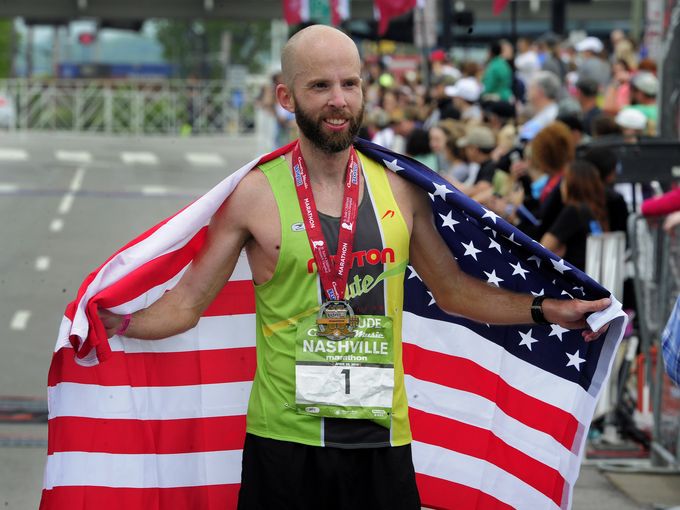
With about a half mile left in the race, I could hear someone closing on me. I was surprised to see it was the Ethiopian girl who I had passed just before the halfway mark.  The Ethiopian girl and eventual winner (2:31:50) pulled ahead and I just tried to stick with her.  I was glad she caught up to me as she helped me to push my pace over the last 1.2 miles.  For mile 26, I ended up running a 5:48, which was my fastest mile since mile 19.  Once I made the turn for the finish I saw the clock approaching 2:32.  I gave everything I had left in the final stretch of the race and finished in 2:31:54, a new marathon PR by 35 seconds!!! 

2:31:54...new marathon PR!
Overall, I'm very happy with my race and PR even though I didn't achieve my 2nd goal of running a sub-2:30.  A 2:31:54 is still a solid time and I can now call myself a 2:31 marathoner, which sounds way much cooler than a 2:32 marathoner.  I still think I have a sub-2:30 in me.  I just might have to find a pancake flat and rhythmic type course to run it, maybe something like Berlin, Chicago, Houston or even Indy Monumental. 

In other results, Justus ran strong to finish in 2:31:03, Scott struggled badly after 20 miles finishing in 2:42:48, and Johnson had some issues with his calves and finished in 2:46:44.

Some thoughts:
I wonder how much my cold had an effect on my performance and how much faster I could have ran if I didn't come up with it the week of the race.  Had I been 95-100% healthy at the start of the race, I think I would have ran 2:30:xx or maybe even dip under 2:30.  The bad thing about a marathon is that you only have one day to showcase your fitness and unfortunately, there are some things you don't have control of that can affect your race. 

The other thing that had an affect my race was the tight left hamstring I encountered starting at 10 miles.  I trained a lot on rolling hills and beat my legs up enough during training, so I don't think the tight hamstring was caused by the hills early in the race.  My thought is that my cold might have stimulated the hamstring tightness.  Regardless, I'm very lucky my hamstring never cramped or seized up, and that I was still able to run well over the last 16 miles.

Splits:


GPS miles splits: 5:41, 5:48, 5:46, 5:44, 5:44, 5:47, 5:43, 5:44, 5:47, 5:41, 5:44, 5:41, 5:42, 5:46, 5:47, 5:41, 5:47, 5:45, 5:48, 5:54, 6:00, 6:02, 5:51, 5:58, 5:51, 5:48, 1:23 (.2 miles).

Nutrition: 
Pre-race: Herbalife24 F1 Sport shake, bagel with peanut butter, 2 bananas, 16oz Herbalife24 Prolong/Prepare, coffee.  I also took in one energy gel right before the start of the race.

Race: I took in an energy gel at miles 5.5, 10.3, 15.5, 17.8 and 20.4, and one Gu offered on the course at mile 23.5. 

Monday, November 30, 2015

California International Marathon Training

California International Marathon is this weekend and I'm looking forward to towing the start line for the second consecutive year.  There’s no doubt in my mind that my fitness is the best it's ever been. My most recent PRs at the half-marathon and 10-mile distances, as well as my workouts during this marathon training cycle, are clear indicators that I’m fit as ever and have a chance at achieving my ultimate goal of running sub-2:30 for the marathon.

Before I recap my CIM training, I want to give a little background of my past marathon training and the changes I’ve made over the last year and a half that has gotten me to my current fitness.

When I first started running marathons in 2003, I relied on running books such as Daniel’s Running Formula and Advanced Marathoning to guide me through marathon training. I would pick out workouts based on what I felt like doing on a given day. It was basically trial and error. Fifteen months after running my first marathon, I dropped my marathon time to 2:42 at the Houston Marathon.
 

It was after the Houston Marathon on January 2005 that I realized I could run faster and possibly even run 6-minute pace for 26.2 miles.  However, I knew I would need a coach to help and guide me through my training, so I contacted Greg McMillan (McMillan Running).  Ironically, I first met Greg while running the Houston Marathon.  I remember around mile 20 of the race, a guy (Greg) on a bike was encouraging me and a few other runners to stay relax and work together.  Apparently, Greg was on the course cheering his athlete and eventual Houston Marathon winner, Kelly Keane.  At the time, I had no idea that Greg was a recognized online coach and famous for his McMillan Running Calculator.


In just one year with McMillan Running, I improved my marathon PR by four minutes to a 2:38 at the Austin Marathon.  I won't go into too much details, but some of Greg's training that helped take my marathon running to the next level included fast-finish long runs, strength-building workouts such as marathon goal pace runs, and cruise/tempo intervals.  You can visit www.mcmillanrunning.com for more of Greg's training philosophy.

I was coached by Greg until 2007 when duty called and had to deploy for the third time in five years. After coming back from a longgg 15-month deployment in 2008, I continued to use Greg's training philosophy and a variety of running books to coach myself. I'd say I did a pretty darn good job, because I had a break-through marathon in 2008 at the Amsterdam Marathon running 2:35:37.  I not only PR’d by over 2 1/2 minutes, but also averaged well under 6:00/mile pace. As a self-coached athlete from 2009-2013 (except for winter/spring of 2011 when Andrew Lemoncello (McMillan Running) coached me for Rotterdam Marathon), I ran a total of 10 marathons, eight (8) of which were faster than 2:37 or sub-6:00 pace (my list of marathon results).

I was happy with my marathon results over those five years, especially that I had lowered my PR down to 2:33:50 and placed well in a few of the popular small-city marathons: 9th at the Munich Marathon, 11th at Big Sur Marathon and 12th at Richmond Marathon.  I even ran well at the big stage, 56th overall at the scorching 2012 Boston Marathon.  But there was one problem.  I was stuck running marathons in the 2:35-2:36 range and had not improved my marathon PR since 10/10/10 at the Munich Marathon.


After having my worst marathon experience and a poor showing (2:53) at last year's (2014) Boston Marathon I realized that I needed some change.  Additionally, at age 38, I knew my chances of improving my marathon PB and getting closer to that illustrious sub-2:30 marathon were diminishing.  So, I decided to get a coach to orchestrate my training and provide some motivation and accountability. My initial thought was to go with McMillan Running again, but as I stated earlier I wanted some change.

I had been following Scott Wietecha's training on his running blog (Running, Rants and Randomness) for some time and really liked his approach to training. Scott, an elementary PE teacher, glorified hobby-jogger for Newton Elite and a 2:17 marathoner, was kind enough to take me under his wing.  Under Scott's guidance over the last year and a half, I've improved my personal bests in the marathon (2:32:29, California Int'l Marathon), half-marathon (1:11:49, Philly Rock 'n' Roll), and 10-Mile (54:35, Army Ten-Miler).  I also ran my 2nd fastest marathon time (2:33:13) earlier this year at Boston in less-than-ideal conditions (headwinds).  I went into Boston in top shape and likely would have ran somewhere around 2:31 had conditions been better.

Scott Wietecha - three-peat Country Music Marathon Champion
Now, with CIM just a week away and having completed my hardest marathon training cycle ever, I'm ready to freshen up the legs and go to war for that sub-2:30.  My only hope is that the weather is good and that I run 2 minutes and 30 seconds faster than I did last year.

Here's a summary of my quality sessions/workouts during the last 12 weeks.  I labeled Q1, Q2, etc. as the number of quality sessions for that specific week.

Week 12: Q1 - 10 miles of alternating 1/2 miles at 5:55 and 5:35; averaged 5:53/5:33 for the recover/fast portions.  Q2 - 15 miles medium long run on rolling route with 4x1/2 mile at marathon effort.  (77 miles)

Week 11: Q1 - 6x1 mile working from 10K pace to slightly faster (5:15, 5:13, 5:12, 5:10, 5:10, 5:09) with 400m rec jog. Q2: 20 miles long run with last 5 miles at MP; ran the last 5M in 28:16 (5:39 pace) 6:27 overall avg pace for the 20 miles (102 miles)

Week 10: Q1 - 12x2:00 at HM pace to slightly faster with 2:00 moderate over rolling hills.  Q2 - 12 miles progression from easy to moderate effort over rolling hills.  Q3 - 19.5 miles long run with 3x4 miles at MP with 3:00 recovery jogs. Ran 22:49, 22:40, and 22:16. (99 miles)

Week 9: Q1 - 12x600m at 5K pace to slightly faster with 1:30 rest.  Q2 - 20 miles progression long run working from moderate pace down to MP; 6:03 avg pace.  (100 miles)

Week 8: Q1 - 10 miles tempo working from slightly slower than MP to slightly faster than MP; 57:03, 5:43 pace). Q2 - Philly Rock 'n' Roll Half Marathon, 1:11:49.  (82 miles)

Week 7: Q1 - 20x 400m at 75-77s with 1:00 rec jog.  Q2 - 4 miles tempo at HM pace plus 6x1/4 mile uphill and 2x1/4 downhill with jog up/down for recovery.  Q3 - 22 miles normal long run with the first half on rolling hills.  (103 miles)

Week 6: Q1 - 6x1 mile starting 5:30 pace and working down to 5:15 with 400m rec jog. Splits were 5:29, 5:25, 5:22, 5:19, 5:14, and 5:12.  Q2 - 20 miles long run with last 6 miles at sub-5:45 pace. 33:57 (5:40 avg) for last 6 miles.  (89 miles)

Week 5: Q1 - 6x1K at 3:10 (3:10, 3:09, 3:08, 3:09, 3:08, 3:09) with 400m rec jog.  Q2 - 9 miles with 4 miles fartlek of .15 miles fast / .35 miles easy.  Q3 - Army Ten-Miler, 54:35.  (77 miles)

Week 4: Q1 - 11 miles with fartlek of 1-2-3-2-1-2-3-2-1 with equal recovery; fast portion at 5:20 pace and moderate recovery at 6:20; averaged 5:16 for fast section and 6:12 for recovery.  Q2 - 12 miles progressing from easy to moderate pace. Q3 - 15 miles with 4x2 miles starting at 5:30 and working down to 5:20 pace (10:56, 10:47, 10:43, 10:39) with 400m rec jog.  (93 miles)

Week 3: Q1 - 2x3 miles tempo (16:41, 16:16) plus 2x800m at sub-2:30 (2:27, 2:27).  Q2 - 9 miles with 4x1/4 mile uphill and 4x1/4 mile downhill with jog down/up recovery.  Q3 - 20 miles long run with middle 14 miles progressing from 6:20 to 6:00 pace; 6:07 overall avg pace.  (100 miles)

Week 2: Q1 - 12 miles with 10x3:00/1:30 fartlek.  Q2 - 8x400m at sub-70s with 400m rec jog.  Q3 - 20 miles normal long run.  (101 miles)

Week 1: Q1 - New Haven 20K Race, 1:10:15.  Q2 - 16x400m at sub-80s with 100m rec jog; averaged 75-76s for the first 8 reps and 73-74s for the last 8.  Q3 - 20 miles long run with the last 5 miles moderate working down to 6:00 pace.  (93 miles)


Tuesday, December 23, 2014

CIM Marathon Training Review

I achieved great success at the California International Marathon (CIM) and it would be a shame if I didn't capture all the things that went well or didn't go so well during my marathon training and CIM race.  

What I did well:
  • Coach. I've been self-coached the past couple years using a mixture of Greg McMillan's training philosophy and Jack Daniel's Running Formula (book).  While I had good success as a self-coached athlete (56th Overall at 2012 Boston, 3rd Place at 2013 Boston2BigSur Challenge, 3rd Place 2014 All-American Marathon), I felt that I needed a coach not only to stay discipline and keep me accountable, but more importantly I felt I needed and wanted to try a different training structure.  Deep inside I wanted to get back to running sub-2:35 or hopefully a PR for the marathon, but knew I would need some guidance and coaching.  Thanks to Coach Scott Wietecha (2:17 Marathon, 63 Half) I was able to run a new PR and break my own Guam National Marathon Record.
  • Miles.  While I've always been a moderate to high-mileage runner, I only averaged about 70-80 miles/week with a few weeks at 80-95 during my previous marathon training cycles.  This time around, during the 18 weeks of training (not including a 2-wk taper) leading up to CIM, I ran 5 weeks at 80-89 miles, 11 weeks at 90-99 miles and one (1) week over 100 miles.  I averaged 89.7 miles during the 18-week marathon training cycle.  
  • Running doubles.  I ran more doubles as part of my mileage increase.  A normal training week consisted of about 11-13 workouts.  It may seem like I had a lot of time on my schedule to run, but that wasn't the case.  During the work week, I would normally have to run my first workout as early as 4:30-5:30am and my second workout during lunch or after work.  On double-days, my 2nd workout was no more than 4-5 miles at a very easy pace.  
  • Take it Easy.  I actually ran "EASY" on my easy days.  After seeing how slow and easy Scott was running his easy runs, I figured I should run my easy runs easier.  I averaged 7:00 pace or slower on my easy runs, whereas I used to average about 6:40-7:00 pace.  The slower pace running allowed me to increase the mileage without feeling very fatigue and saved the legs for the faster workouts.    

  • Progression Runs.  I ran a lot of my quality workouts as a progression run.  It didn't matter if it was an interval session on the track, mile repeats, tempo run, or marathon pace workout, I ran or tried to run a faster pace as the workout progressed.  This was key because it taught me how to be patient early and to save the faster running for the second half of the workout/race, therefore running negative splits.   CIM was a perfect example: I ran negative split halves of 1:16:41 and 1:15:48, with the last 10K being my fastest section of the marathon.  
  • Long Runs.  I alternated my weekly long runs between normal long runs and long run variations mostly on rolling terrain to simulate the CIM course.  The long run variations included workouts at marathon effort/pace or faster.  There were a couple long run workouts that I thought were key during my train-up.  One was an 18-miler at 4300 ft elevation that consisted of 5x2 miles at marathon effort.  Each 2-mile rep was faster than the previous.  The other key long run workout contained 10 miles of 1/2 mile steady (6:15-6:20pace) followed by 1/2 mile hard (5:30-5:40ish pace) on rolling hills.  I also ran many of my long runs without taking in any fuel (electrolytes, gels, etc.), i.e. glycogen-depleting long runs, which teaches the body to metabolize fat more efficiently and enables runners to maintain race pace longer.   
  • Altitude Training.  I was fortunate to get in 5 solid weeks of moderate altitude (3900 ft) training while at Fort Bliss (El Paso), TX for work.  Studies have shown that moderate altitude training improves performance.  (Zap Fitness trains at moderate altitude of 3500-4000 ft.) I'm sure I reaped some benefits from the 5 weeks of altitude training.  I averaged just under 93 miles/week and got in some very good quality sessions.  
  • Nutrition. I stuck to what works for me.  I always took in my Herbalife24 (HL24) Rebuild Endurance recovery shake immediately after my workout.  Pre-race: I ate lots of carbs the two nights before the race and stayed hydrated.  On the morning of the race I had my usual pre-race meal: bagel, HL24 Formula 1 Sport shake, yogurt, banana and coffee.  During the race, I consumed a total of 5 PowerGels and 1 GU (offered on the course).  I also alternated my hydration between an electrolyte drink (Nuun) and water at each aid station.  I think I only skipped one aid station.  
  • Race strategy.  I think the one thing I'm good at with marathons is running my own race.  It's very rare that I'll get suckered into going out too hard or running faster than I should be running.  At CIM, I was patient early in the race and did not push the pace even when things felt very easy and comfortable.  Obviously, it paid off because I ran a huge negative split and did not die in the end.  
Run your own race.

What I can do better at:
  • Stretching.  I'm horrible at it.  I'll be honest, I did almost no stretching besides maybe some calf and quad stretches (for about 15 sec) immediately after my runs.  I don't think it's a matter of not wanting to do it, but not having the time to do it (excuses).    
  • Core exercises or cross-training.  I'm usually good about doing my core exercises or some cross-training, but during this training cycle I was not consistent with doing them.    I need to get back at it to ensure I stay injury-free.
  • Races.  I like to run races, but it didn't seem like I raced much or maybe I did.  I think I felt like I didn't race much because I ran most of my races (ran a total of 4 races between Jul-Nov), besides Philly Half, as tempo runs or hard workouts.  
With CIM in the books, it's now time to look ahead towards my next big race, 2015 Boston Marathon.  My plan is to continue doing the things I did well for CIM and improve on the things I didn't do so well.  I already started incorporating some structured stretching after my runs.  

Thursday, December 11, 2014

California International Marathon (CIM)

I was really looking forward to CIM. I had an excellent build up, trained hard and was eager to redeem myself after a couple sub-par marathons earlier this year. My 1:13 Philly half-marathon in September followed by five solid weeks of moderate altitude training in El Paso indicated I was fit and ready to run close to or faster than my personal best. My main goal entering this race was to run 2:35 or better, which I haven't done in over 3 years. However, in the back of my mind, I truly wanted to run a new marathon personal best. CIM was the right marathon to take a shot at a new marathon PR because of its fast course (but not easy) and the depth of runners in the 2:30s. 


I woke up at 4am and went downstairs to the hotel dining area for breakfast. I had my usual pre-race meal: a bagel with peanut butter and jelly, yogurt, banana, Herbalife24 Formula 1 Sport shake and a cup of coffee. An hour later I hopped on the runners' shuttle bus to Folsom. When we got to Folsom I remained on the bus to stay warm and hydrated with Herbalife24 Prolong. About 30 minutes before the start I went for a mile jog, did some strides and then headed to the start line. At the start I lined up about five rows back so I wouldn't take off like I was running a 5K. 


When the race started I slowly settled into what felt like marathon pace/effort, around 5:50-5:55 pace. About a mile into the race, I found myself running alongside a pack of about 8-10 girls.  I'm sure the girls were all aiming for the US Olympic Marathon Trials A (2:37) or B (2:43) Standard. I asked the guy leading the pack what pace he was running, and he responded with 2:37 and that he was running the entire marathon. I was actually surprised because we had split Mile 1 at 5:52, which in my mind was a little too fast for a 2:37 marathon. The pacer might have realized it because I didn't see him or the pack of girls shortly after. (I later read that a total of 20 US women and 10 men qualified for the 2016 Olympics Marathon Trials.)

I clicked off mostly 5:52's for the first 6 miles (5:52, 5:53, 5:49, 5:52, 5:49, and 5:52) feeling comfortable and smooth.  At 4 miles I was 10 meters behind a pack of about 12 runners which was being led by Michael Wardian.  Mike had competed in the North Face Endurance 50-miler in San Francisco the day before. I'm not sure if he even had time to clean up after the 50-miler.  The guy's a Beast!  I thought about putting in a surge to catch up to the pack, but decided not to since I was more focused on running my own race.  It was the right decision because within a few miles after the 10K mark, which I crossed in 36:31, the pack began to string out and I eventually overtook most of the runners with the exception of Mike and a couple other guys. I took my first gel at 5.5 miles.

I hit the half-marathon mark in 1:16:41 still feeling great.  The hills in the first half were noticeable, but not steep or long enough to break up my rhythm. The hill I remember most was the semi steep hill on Sunrise Blvd around 10.5 miles.  The steep hill is part of the San Juan Hills which rolls from miles 10.5 to 13.  Approaching Sunrise Blvd we ran ran downhill and then climbed a hill that was about a 1/4 mile long.  I think my strong hill running ability showed here because I ran splits of 5:47, 5:48 and 5:51 on the San Juan Hills (11-13 miles).  I was well prepared for the hills and the rolling course because 1) my coach (Scott) put together a solid training schedule that incorporated some intense training on rolling terrain, and 2) I trained on hills that were steeper in grade and longer than the CIM hills.  I took my second gel at the 13 mile mark. Splits for Miles 7-13 were: 5:52, 5:56, 5:54, 5:47, 5:47, 5:48, and 5:51.  


Miles 14-20 were uneventful.  I continued to throw down splits between 5:47-5:53 (5:53, 5:53, 5:48, 5:52, 5:51, 5:43, and 5:50).  During this stretch of the race I took in a gel at miles 16.5 and 19.4.  At Mile 20 (1:56:57 - 5:51 pace), I was still feeling good, but was a little worried I'd suddenly encounter a cramp in my legs.  In my last two marathons (2014 Boston Marathon and All-American Marathon), I cramped badly between 18-20 miles and suffered through the last 10K of those races.  I didn't want to experience the suffering again.  

Around Mile 21, I passed the women's pre-race favorite and 2:27 marathoner, Renee Metivier Baillie.  I was surprised and felt bad to see Renee, because she was hoping to take down the 2:29 course record and was obviously not having a good day.  Shortly after passing Renee I had a little scare.  I felt a minor twinge on my left hamstring, almost as if a cramp was about to happen.  To fight off the developing cramp, I took in my last gel (carried 5 with me) and some Nuun, an electrolyte drink offered on the course.    The gel and electrolytes must have helped because I didn't break a stride and ran splits of 5:48 and 5:49 for Miles 21 and 22.  On the 23rd mile, I felt another twinge on the same spot.  Luckily, there was an aid station at 23.5 miles that offered GU.  I took a GU and drank two cups of Nuun at the aid station.  The fuel must have worked again because I ran 5:43 and 5:48 for Miles 23 and 24.  I don't know what flavor of GU it was, but it didn't taste all that good and I really didn't care.  I just didn't want to cramp this late in the race when I was on pace to run a PR.
  
With only a couple more miles to go, I kept telling myself to relax and stay focus.  Around Mile 25, I caught up to Mike Wardian and briefly chatted with him.  For some reason, seeing and catching up to Mike gave me a boost of confidence.  I told Mike that I was having a good race and was on pace to run a PR.  He told me to Go Get It!  Mike finished in an impressive 2:33 following a 50-miler. Impressive!  Mile 25 was a 5:48. In the last mile, I pretty much gave it my all.  With about a half mile to the finish, I passed the 3rd place female, Kristen Zaitz, and was closing in on the 2nd place female, Jane Kibii.  Unfortunately, I ran out of real estate and could not overtake Jane.  My Mile 26 split (5:33) was the fastest split of the race.  


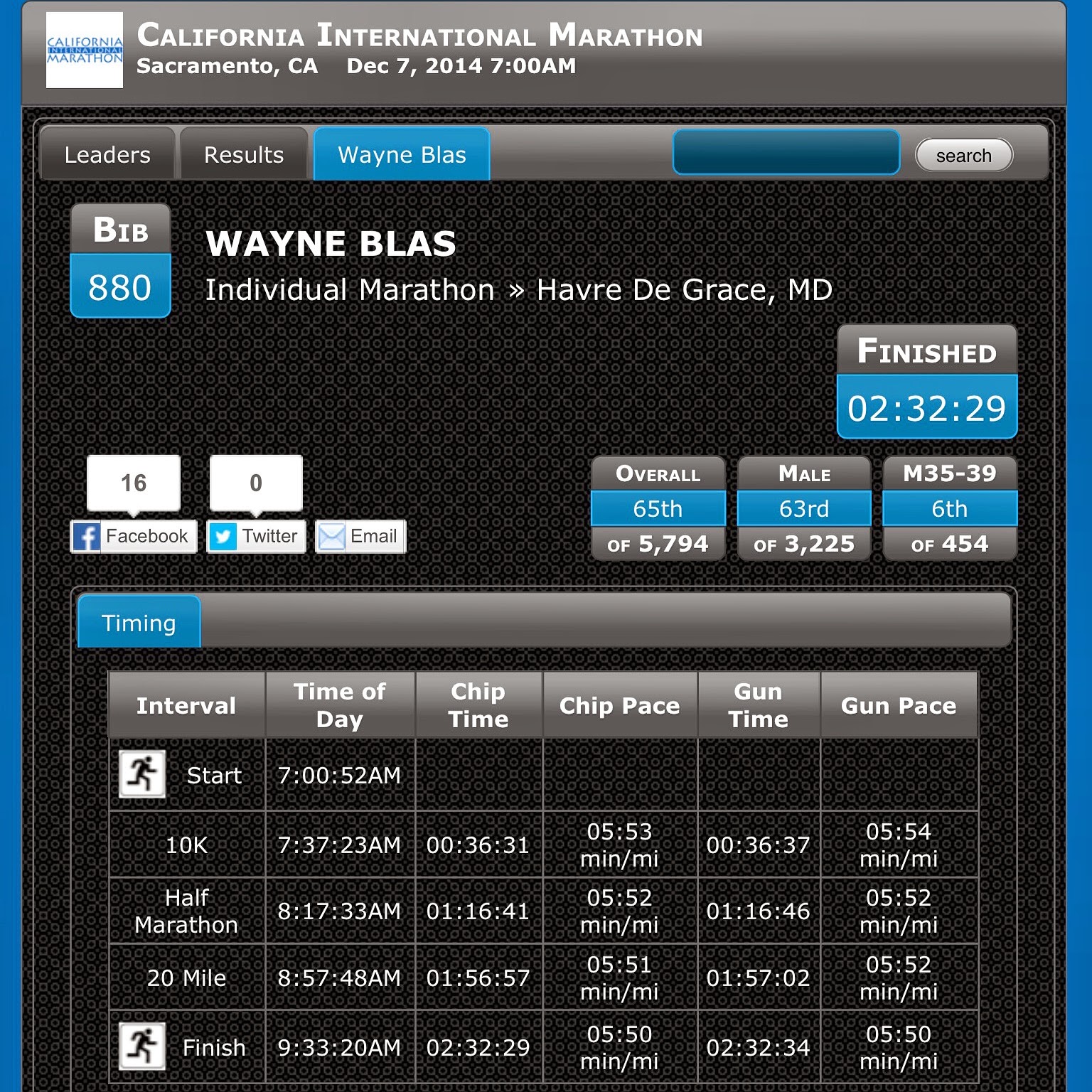
The CIM Finish can be heart-breaking to runners because you can't see the finish line from 8th St.  It's not until runners make the turn onto Capitol Mall that they'll see the finish about 50 meters ahead.  When I turned onto Capitol Mall I saw the clock read 2:32:xx.  I was so happy I started celebrating by throwing fist pumps in the air as I approached the finish.  I crossed the finish with an official time of 2:32:29, a personal best by 1:21.  


CIM Finish.

As my coach said, I ran this race like a pro.  I've ran negative splits for the marathon a few times, but I've never ran almost a minute faster for the 2nd half.  I ran the 1st and 2nd halves of the race in 1:16:41 and 1:15:48, a 53 second negative split.  I also ran the last 10K of the race in 35:32 (5:44 pace), which is the fastest 10K split in all of my marathons.  Below are my official splits and GPS splits:


Mile  Split
1       5:52
2       5:53
3       5:49
4       5:52
5       5:49
6       5:52
7       5:52
8       5:56
9       5:54
10     5:47
11     5:47
12     5:48
13     5:51
14     5:53
15     5:53
16     5:48
17     5:52
18     5:51
19     5:43
20     5:50
21     5:49
22     5:50
23     5:47
24     5:43
25     5:48
26     5:33

Tuesday, December 09, 2014

December 1 - 7 Training

Mon: 6.2 miles easy (7:18)

Tue: 8.2 miles with 2x2 miles at MP (5:50-5:55). Felt good and comfortable. First 2M was in 11:38 (5:48, 5:50) and the 2nd in 11:39 (5:49, 5:50).  The legs felt like it wanted to go faster but I tried to stay within range. 

Wed: 6.2 miles easy (7:29) I ran sort of a hilly route so I would run very easy. 

Thu: 7.2 miles with 2x1/2 mile at half-marathon effort with 1/2 mile easy. Leg turnover felt good.  I didn't worry about splits but it was nice to know that I ran 5:30 pace, which is what the effort felt like.  

Fri: 3 miles very easy (7:38)

Sat: 4 miles easy with 2x30s pick-ups (7:30)

Sun: 27.2 miles with California International Marathon (CIM) in 2:32:29, 64th Overall & 6th AG. It was a new Personal Best by 1:21 and new Guam National Record for the Marathon. As my coach said, I ran this race like a Pro.  My half splits were 1:16:41 & 1:15:48, the last 10K in 35:32 (5:43 pace), and the last mile in 5:33.  

Weekly Total: 62 miles in 7 days/7 runs
CIM was by far my best executed race.  I was patient, ran comfortable early and then dropped the pace in the later part of the race.  Race report to follow.